
Last Updated: November 7, 2026
Quick Summary
Affordable boutique clothing in Canada typically runs $35 to $70 for tops, $45 to $90 for dresses, and $60 to $110 for denim. To judge real value, check fabric composition, stretch recovery, and seam construction, then calculate cost per wear and landed cost before checkout.
- A $60 pair of jeans worn twice weekly for a year costs about $0.58 per wear.
- Stretch percentage above 5% means size down, not up.
- A $12 flat shipping rate on a $45 top is a 27% surcharge.
- Domestic Canadian shipments carry no customs duties, but GST/HST still applies at checkout.
- Compare garment measurements, not size labels, against a piece you already own and like.
Table of Contents
- What Affordable Boutique Clothing Actually Costs in Canada
- How to Spot Quality Affordable Women's Clothing Before You Buy
- Affordable Women's Clothing Boutiques: What Sets Them Apart
- Canadian Online Clothing Boutiques: Shipping, Returns and Local Pickup
- Building a Wardrobe From Under $100 Pieces
- Inclusive Sizing and Fit: Questions to Ask Before You Order
- Shop the Curated Collection and Find Your Fit
- Frequently Asked Questions
What Affordable Boutique Clothing Actually Costs in Canada
Affordable boutique clothing in Canada sits in a narrow band between fast fashion and designer retail, and knowing where that band falls changes how you shop. Boutiques are competing hard for the same customer, which makes price transparency more important than ever. At JW Rose Boutique, we price every piece so a working wardrobe can be built one purchase at a time, not one splurge.
Price Benchmarks by Category
Our own tops start at $35, dresses at $45, and jeans at $60.
| Category | Boutique Range | What Drives the Price |
|---|---|---|
| Tops and blouses | $35-$70 | Fabric weight, lining, finishing |
| Dresses | $45-$90 | Cut complexity, stretch, lining |
| Denim | $60-$110 | Rise, stretch content, wash |
| Knitwear | $45-$70 | Yarn blend, gauge, detail work |
| Outerwear and blazers | $50-$120 | Structure, lining, hardware |
Boutique Range
How to Spot Quality Affordable Women's Clothing Before You Buy
Quality affordable women's clothing comes down to three checks: fabric composition, stretch recovery, and seam construction. Read the label before you read the price tag, because composition predicts how a piece will wash, drape, and hold shape.
Fabric, Stretch and Cost Per Wear
Cost per wear is the purchase price divided by the number of times you realistically wear a piece. A $60 pair of jeans worn twice a week for a year costs about $0.58 per wear. A $25 pair worn four times costs $6.25.
- Cotton-heavy denim holds shape and breathes; our KanCan jeans are 70% cotton, 20% polyester and 2% spandex.
- Polyester blends resist wrinkles and travel well but pill faster at friction points.
- Acrylic knits feel soft and light; they need cold washing to avoid stretching.
- Stretch percentage above 5% means size down, not up.
For a deeper breakdown of fiber behavior, see our guide to the best fabrics for busy lifestyles.
Affordable Women's Clothing Boutiques: What Sets Them Apart
Affordable women's clothing boutiques differ from big-box retail in one structural way: a buyer chooses each piece instead of a planogram choosing it for them. That means smaller runs, faster sell-throughs, and fewer markdowns that gut the value of what you already bought.
Curious about the wider case for shopping small? Our article on the benefits of shopping at local Canadian boutiques covers it in detail.
Canadian Online Clothing Boutiques: Shipping, Returns and Local Pickup
Shipping and returns decide whether a boutique purchase is genuinely affordable. A $50 dress with $15 return shipping and a restocking fee is a $65 dress the moment it does not fit. The only way to compare boutiques fairly is to calculate the landed cost before you check out, not after.
The Landed-Cost Formula
Landed cost is the item price plus shipping plus any return shipping you are likely to pay, minus the value of anything you keep. Run it in three steps:
- Add the shipping charge or confirm the free-shipping threshold. A $12 flat rate on a $45 top is a 27% surcharge. If the threshold is $100, ask whether adding a $55 basic you actually need is cheaper than paying $12 twice across two orders.
- Check whether the price includes tax and duties. For a domestic shipment within Canada, there are no customs duties, but GST/HST still applies and is usually added at checkout. Cross-border shipments can attract duty, brokerage, and tax on delivery, so confirm who pays before ordering.
- Price the return. If return shipping is $15 and the item was $50, a fit failure costs 30% of the purchase. Free exchanges remove most of that risk; refund-only policies with a fee do not.
What to Confirm Before Checkout
-
A published shipping threshold and flat rate, not a "calculated at checkout" surprise
-
Whether sale and final-sale items are excluded, and whether that exclusion is stated on the product page
-
Local pickup if you are near the shop, which removes shipping cost and lets you try before committing
Duties, Taxes, and the Made-in-Canada Question
Buying from a Canadian-owned boutique does not automatically mean the garment was made in Canada. "Canadian-owned" describes the business; "made in Canada" describes the product, and the two carry different cost and return implications. A domestic shipment avoids customs duty and brokerage, while a cross-border shipment may not. If local manufacturing matters to you, look for a stated country of origin on the product page rather than assuming it from the retailer's location.
New to ordering this way? Read our walkthrough on how to order from an online boutique shipping to Canada.
Building a Wardrobe From Under $100 Pieces
A wardrobe built from under-$100 pieces works when you buy anchors first and accents second. Five well-chosen items cover most of a working week, and each one should pair with at least three things you already own.
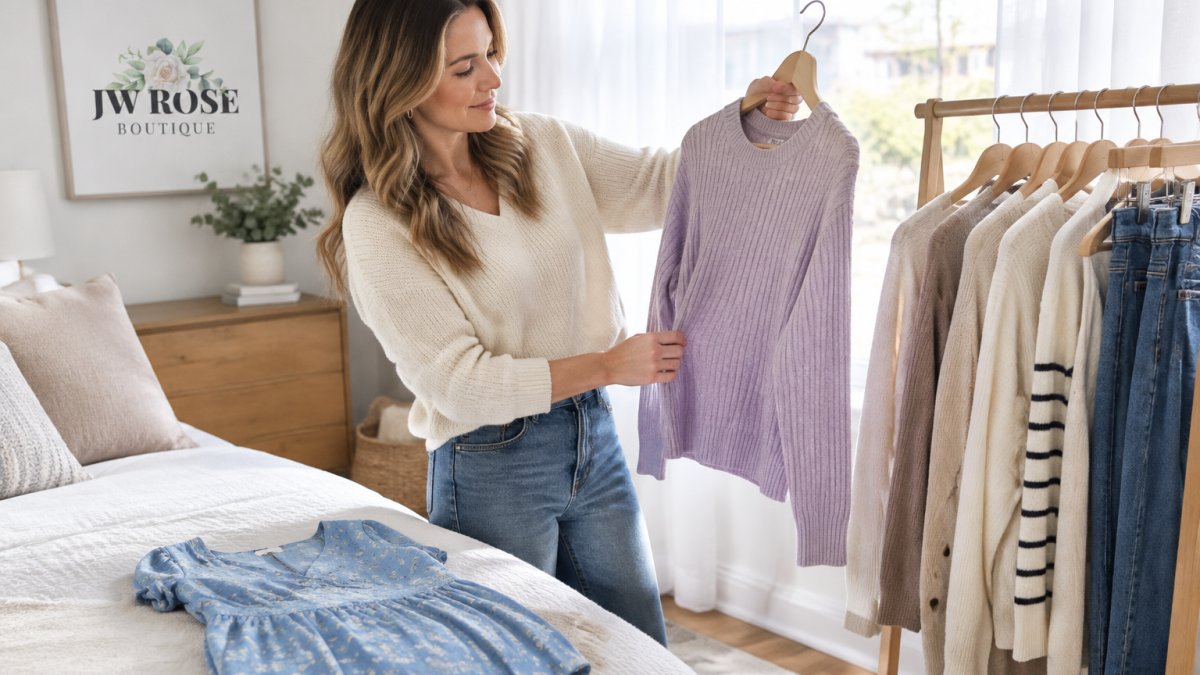
Dresses, Tops and Denim That Earn Their Place
Start with pieces that work in more than one setting:
- The $45 Better than Basics dress in sky blue: medium stretch, ruched waist, works for the office and a dinner.
- The $50 Black Blazer Jacket: turns a plain top into a work outfit instantly.
- The $35 High Neck Multi Colour Blouse: flowy enough for summer alone, layerable under a blazer in winter.
- The $60 KanCan High Rise Skinny Jeans: stretchy enough to size down, soft enough to wear all day.
- The $45 Chunky Knit Open Cardigan: oversized, pockets, layers over everything.
Browse the full range of tops to fill the gaps around them.
Inclusive Sizing and Fit: Questions to Ask Before You Order
Inclusive sizing means a real size range with consistent grading, not a single extended size added to a straight-size run. The practical test is whether the same style is graded across the full range with the same construction, and whether the listing gives you enough measurements to choose without guessing.
Read the Size Chart Like a Measurement, Not a Label
A size label is a marketing decision; a garment measurement is a fact. Before ordering, compare three numbers against a piece you already own and like:
- Bust or chest, measured flat across the front and doubled
- Waist, measured at the narrowest point of the garment
- Hip, measured about 20 cm below the waist seam
Lay your best-fitting top flat, measure it the same way, and match that number to the chart rather than matching the letter on the tag. Sizes vary between labels, and a medium from one buyer can measure like a small from another.
What Grading Actually Means
Grading is how a pattern is scaled from the base size to the rest of the range. A well-graded piece adds proportionate room at the bust, waist, and hip as sizes increase; a poorly graded one simply widens the whole garment, which produces gaping armholes and a tight hip.
Fit Notes That Change the Decision
Fit notes matter more than a size chart alone. "True to size, relaxed fit" and "true to size, bodycon" describe very different garments at the same label size. Look for:
- The model's height and the size she is wearing, so you can scale the drape to your own frame
- Stretch percentage and recovery, because a knit with 5% or more elastane will relax with wear and may warrant sizing down
Watch out: a size chart that lists body measurements without garment measurements tells you who the piece is designed for, not how this specific cut will fit. When only body measurements are published, size to your largest measurement and plan to tailor.
Fit Guidance by Category
- Dresses: check the waist seam position and whether the fabric has stretch; a ruched or wrap style tolerates a wider fit range than a structured sheath.
- Tops and blouses: compare shoulder width and bust; a flowy cut hides a small difference, a fitted one does not.
- Denim: rise and stretch content decide the fit more than the waist number. High-rise with 2% elastane recovers; rigid denim does not.
- Knitwear: oversized cuts are forgiving, but check sleeve length and body length against a sweater you already own.
For size-specific outfit guidance, our stylish clothes for size 14 guide is a useful starting point.
Shop the Curated Collection and Find Your Fit
Affordable boutique clothing in Canada rewards a short list and a sharp eye. Buy anchors, check the fabric label, confirm the return terms, and calculate cost per wear before you commit. That discipline is what separates a wardrobe that lasts from a closet full of mistakes.
JW Rose Boutique is run by a full-time working mom who curates every piece for comfort and quality. We offer local pickup, in-person open houses for trying things on, and flexible payment options with interest-free installments.
Ready to build a wardrobe that works as hard as you do? Start with our curated collection and find the pieces that fit your week.
Frequently Asked Questions
Where can I buy affordable boutique clothing online in Canada?
Start with boutiques that publish clear prices and fabric details on their product pages, then check whether they offer local pickup or in-person try-ons. JW Rose Boutique, for example, lists pieces from $35 to $68, including a $35 High Neck Multi Colour Blouse and $60 KanCan High Rise Skinny Jeans, with local pickup and open-house try-on options. Compare the listed price against how often you will wear the piece before you commit.
How do I know if affordable boutique clothing is good quality?
Read the fabric composition and the care instructions, not just the photos. A pair of jeans with 70% cotton, 20% polyester and 2% spandex, like the KanCan High Rise Skinny Jeans at $60, tells you it will stretch and recover rather than bag out. Check whether seams are described, whether linings are listed, and whether the boutique states fit notes such as true to size or size down. Fewer, better-described pieces beat a page of vague listings.
Are there Canadian-owned online clothing boutiques that ship across the country?
Ask whether a boutique ships within Canada, what the shipping threshold is, and how returns and exchanges work before you order. Local pickup gives you a fallback if a size misses. Check the product page for final-sale notes before you buy.
What should I look for when shopping at a clothing boutique on a budget?
Look for transparent pricing by category, a stated size range, and fabric details on every listing. A boutique that shows a $45 dress alongside its material (60% polyester, 35% cotton, 5% spandex, for instance) lets you judge cost per wear honestly. Check whether payment plans are interest-free and whether you can try pieces on in person. Those four checks separate a real boutique from a dropship page.
Do online boutiques offer local pickup or in-person try-ons?
Some do, and it is worth asking directly. Local pickup and open-house try-on events solve the biggest objection to buying boutique clothing online: not knowing how a piece will fit. If you live outside the pickup area, confirm Canada-wide delivery and the return process instead.
