
Last Updated: November 10, 2026
Quick Summary
Choose flattering outfits by starting with fit rather than body-type rules: check that shoulder seams sit on your shoulder bone, read how the fabric drapes or clings, and confirm you can move and sit comfortably. Run a fitting-room sequence that starts with your measurements against the size chart and ends with a movement test before you cut the tags.
- Waist definition uses a garment's cut to suggest where your waist sits, no cinching required.
- For pear shape, keep the waist clean and let A-line or full skirts fall away from the hip.
- Hold a color near your face in daylight; even skin and bright eyes mean it works.
- Between sizes, size to the larger bust or hip measurement and plan to tailor the waist.
- Decide within 48 hours and return the wrong size instead of keeping it just in case.
Table of Contents
- Start With Fit, Not Body-Type Rules
- How to Dress for Your Body Shape Without the Rigid Labels
- How to Find Flattering Skirts for Pear Shape
- How to Choose Colors That Complement Your Skin Tone
- A Fitting-Room Decision Process You Can Use Online
- Fabric, Stretch and Structure: What Actually Changes the Drape
- Flattering Outfits for Work, Weekends and Occasions
- Build Your Own Flattering Outfit With JW Rose Boutique
- Frequently Asked Questions
Start With Fit, Not Body-Type Rules
Most style advice starts with the wrong question: what shape are you, then a list of rules. Learning how to choose flattering outfits starts with fit, not labels. A well-fitted garment in a color you love beats a "correct" silhouette that pulls, gapes or digs in every time you move.
Here is the reframe: flattering outfits are garments that follow your body's lines and let you move. Nothing more mystical than that.
Three things decide whether a piece flatters you:
- Fit at the seams. Shoulder seams sit on your shoulder bone, not past it.
- Fabric behavior. Does it drape, hold shape, or cling?
- Your comfort. If you tug at it all day, it is not flattering. Confidence is the whole point.
Below, we walk through a repeatable method you can use online, in a fitting room, or from your couch.
How to Dress for Your Body Shape Without the Rigid Labels
Body-shape systems can help you notice proportions. They should never become a checklist you fail.
The guidance on healthy body image from Canada's national mental health resources makes a useful point: rigid rules about how bodies "should" look tend to hurt more than help. So we treat shape categories as a starting point, not a verdict.
A practical way to use them: look at where your body carries width and where it carries length. Then use clothing to create visual balance. That is the whole game.
Waist Definition and Visual Balance
Waist definition is the practice of using a garment's cut to suggest where your waist sits. It does not require a cinched belt or a small waist. It requires a garment that narrows at the right point.
Try these:
- A wrap dress that ties at your natural waist
- A belted silhouette over a straight tunic
- A fit-and-flare cut that nips in then releases
- High-waisted pants that sit at your narrowest point
If belts feel fussy, seams and ruching do the same job. Our Better than Basics- Sky Blue Dress has ruching at the waist.

Necklines, Sleeves and Shoulder Width
Necklines change how your shoulder width reads before anyone meets you.
- Open necklines and V-necks draw the eye down and lengthen the neck.
- High necks add polish but can shorten a short neck; balance with a long earring.
- Straight sleeves that end at the wrist create a clean vertical line.
- A sleeve that stops at the widest part of your arm draws attention there instead.
Watch out: a shoulder seam that hangs past your shoulder bone makes every jacket look borrowed. Check that seam first, every time.
How to Find Flattering Skirts for Pear Shape
Finding flattering skirts for pear shape comes down to one move: keep the waist clean and let the skirt fall away from the hip. A pear shape carries width through the hip and thigh, so a skirt that skims rather than clings will always look better.
Here is what works:
- A-line and full skirts that flare from the waist
- Pencil skirts in fabric with real stretch, not thin jersey
- Darker colors and matte textures through the hip
- Detail at the waist like a seam, tie or pleat
What usually backfires: stiff pleats that add bulk at the hip, or a skirt so tight it pulls across the thigh when you sit. Sit down in the fitting room. Always.
How to Choose Colors That Complement Your Skin Tone
Choosing colors that complement your skin tone is simpler than the internet makes it sound. Hold a garment near your face in daylight. If your skin looks even and your eyes look bright, the color works. If you look washed out or gray, it does not.
Three quick checks:
- Vein test. Blue-ish veins often suit cool tones; green-ish veins often suit warm tones.
- Gold or silver. Which jewelry makes your skin glow? That is your undertone hint.
- The five-second face test. Does the color make you look awake? Buy it.
Ignore the seasonal color charts if they fight your gut. Personal style beats a palette.
A Fitting-Room Decision Process You Can Use Online
Online shopping fails on fit, not style. Build a decision process you run every time, in a store or from your couch.
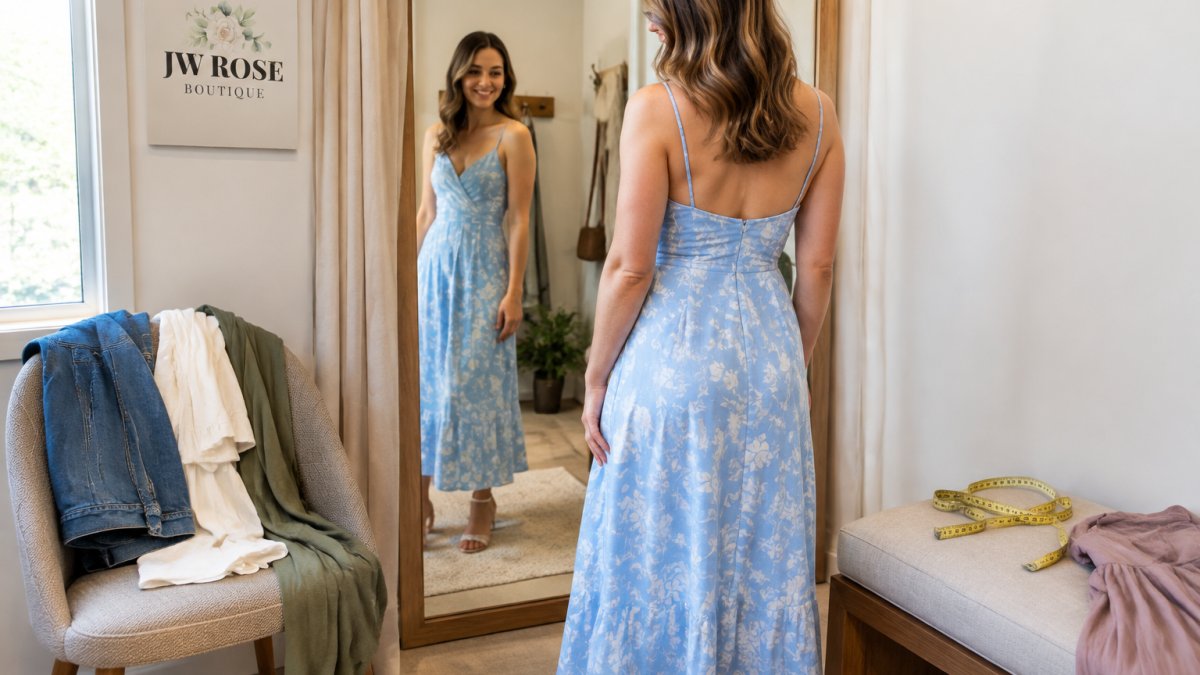
Run this sequence in order. Stop at the first failure and either size up, try another cut, or return it.
**1.
2. Read the fabric content and stretch percentage. A garment with 2% elastane behaves differently from one with 20%.
**3.
**4.
**5.
**6.
**7.
8. Decide within 48 hours. Ordering two sizes "to be safe" and never returning the wrong one is a common pattern. Return it.
This process works across sizes and body changes. Between sizes, size to the larger bust or hip measurement and plan to tailor the waist.
If you are unsure how to measure yourself, our guide on how to find your clothing size online walks through it step by step.
Watch out: a garment that fits standing but fails the sit test will spend its life in the back of the closet.
Run this sequence in order and stop at the first failure.
| Step | What to do | Note |
|---|---|---|
| 1 | Measure bust, waist, hip, inseam; compare to size chart | Sizes vary by brand |
| 2 | Read fabric content and stretch percentage | If stretch not stated, assume none |
| 3 | Check model's height and size when listed | Calibrate length and volume |
| 4 | Confirm return window and process before buying | Know if returns are free |
| 5 | Try on at home within return window, tags on | Do the movement test |
| 6 | Check seams and stress points | Shoulder seams on shoulder bone |
| 7 | Look for fit faults and name them | Naming the fault tells you what to change |
| 8 | Decide within 48 hours | Return the wrong size |
Fabric, Stretch and Structure: What Actually Changes the Drape
Fabric has a large influence on how a garment looks and fits.
Four properties matter most:
- Stretch lets a fitted piece move with you. A small amount (2-5% elastane) improves recovery and comfort; a large amount (15-20%) is forgiving but can cling and show every line.
- Structure holds a shape. Tailored wool, heavy cotton, and lined garments keep their line and skim rather than cling, your friend through the hip and thigh.
- Drape is how fabric falls. Soft drape (viscose, modal, fine knit) skims and moves; stiff drape (taffeta, heavy linen, crisp poplin) stands away from the body. Neither is better; they solve different problems.
- Recovery is how fabric returns to shape after stretching. Good recovery keeps a garment fitted all day; poor recovery leaves knees and elbows bagged out by noon.
Most fit problems are fabric problems in disguise. Here is how to spot each one and what to do:
Pulling across the bust or back. Horizontal tension lines mean the garment is too small there or the fabric has too little give. Fix: size up, choose a roomier cut through the bust, or pick moderate stretch. Tailoring cannot add fabric that is not there.
Gaping at the button placket. The fabric is too stiff or the cut too narrow through the bust.
Bunching at the back waist or hips. Excess fabric has nowhere to go, usually because the torso length or rise is wrong for your proportions.
Riding up at the hem. The cut is too narrow for your stride or the fabric is too stiff to fall.
Transparency. Thin, light-colored fabric shows seams, undergarment lines, and skin tone differences. Fix: choose a lined version, a darker color, or a heavier weight.
Poor drape that clings. Thin jersey and cheap viscose cling to every curve and reveal undergarment lines.
Bagging at knees and elbows. Poor recovery means the fabric stretches and stays stretched.
Layering and texture matter too. For a deeper look, see our guide to the best fabrics for busy lifestyles.
Watch out: a garment that fits perfectly in the dressing room but bags out by lunch is a fabric failure, not a size failure.
Flattering Outfits for Work, Weekends and Occasions
The same body needs different outfits for different rooms. Dress codes change the rules, not your proportions.
For work: a fitted top, a tailored jacket and wide-leg trousers. Our High Neck Multi Colour Blouse is flowy enough to layer under a blazer and still looks polished alone.

For weekends: high-waisted pants with a soft knit, or a midi dress and flat boots. Comfort first, always.
For occasions: one strong piece, then keep everything else quiet. Our Long Sleeve Ruched Bodycon Dress has ruching and a faux-wrap line.

For more weekday-ready ideas, browse our picks for comfortable work clothes.
Build Your Own Flattering Outfit With JW Rose Boutique
The best flattering outfits come from a small, well-chosen wardrobe you actually wear. That is what we build at JW Rose Boutique.
We are a curated boutique run by a dedicated working mom, so we choose pieces for real days. That means:
- Local pickup if you are nearby
- In-person open houses so you can try pieces on before committing
- Flexible payment options with interest-free installments to spread the cost
If you want help building outfits around your own body and budget, our guide on choosing a personal stylist explains what to look for. And if you are a size 14 working out how these ideas apply to you, our size 14 outfit guide has concrete examples.
Ready to stop guessing and start wearing clothes that fit? Shop our latest arrivals and build a wardrobe that works with your body, your budget and your week. Get started with JW Rose Boutique and find pieces you will reach for again and again.
Frequently Asked Questions
How do I identify my body shape?
Measure your shoulders, bust, waist and hips in centimetres and compare the four numbers rather than eyeballing a mirror. If your hips are the widest measurement, you sit in the pear category. If shoulders and hips are close and the waist is clearly narrower, that reads as hourglass. If shoulders are widest, it is inverted triangle. Treat the result as a starting point for silhouette choices, not a rulebook, and re-measure after any significant weight change so your flattering outfits still work.
How can I tell if a piece of clothing will look good on me before buying?
Check the size chart against your own measurements, then read the fabric content and stretch description. A dress listed as medium stretch with ruching at the waist, like the Better than Basics Sky Blue Dress at $45.00, will behave very differently from a structured woven piece. Look for a model height and size note, compare the garment's cut to something you already own and love, and confirm the return window before you order so a bad fit is not a costly mistake.
What role does fabric choice play in how an outfit fits?
Fabric decides whether a garment skims or clings. Blends with spandex, such as the 60% polyester, 35% cotton and 5% spandex mix in the Better Than Basics Olive Dress at $50.00, give medium stretch and hold a fitted shape without pulling. Flowy polyester, like the High Neck Multi Colour Blouse at $35.00, drapes away from the body and hides creases. Structure matters too: a tailored jacket or belted silhouette creates waist definition that a soft knit will not.
How do I balance comfort and style when choosing outfits?
Prioritize the pieces you will actually wear for a full day. Test movement before you commit: sit, reach overhead and walk a few steps. Stretchy material and draping help, and layering lets you adjust through the day. If you are ordering online, use local pickup or an in-person try-on where available so you can confirm comfort before keeping a piece. Comfort and confidence feed each other, and an outfit you fidget in never reads as flattering.
